
Gutters
Why Gutter Joints Fail and What On-Site Fabrication Fixes
October 20, 2026
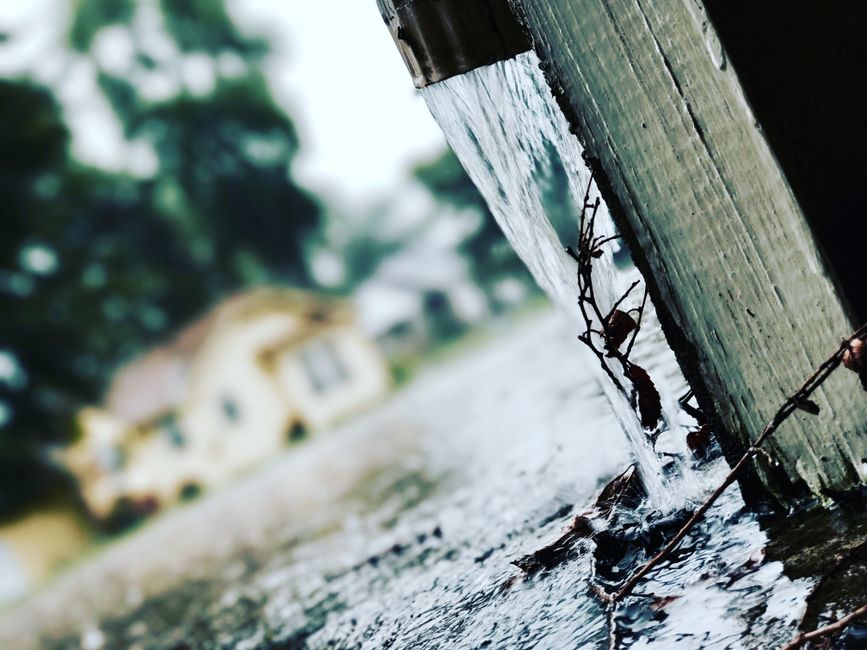
Most gutter leaks start at a joint. A sectional gutter system connects pre-cut lengths — typically ten feet — with overlapping connectors and sealant. Every one of those connections is a point where water can find a path through. Understanding why joints fail explains why on-site fabrication produces a more durable result.
What Happens at a Gutter Joint
A sectional joint relies on a bead of butyl or silicone sealant pressed between two overlapping pieces of aluminum. New, that sealant is flexible and watertight. But gutters live outside, exposed to UV radiation, temperature swings, and the mechanical stress of debris loads and cleaning.
In Greater Cincinnati, freeze-thaw cycling accelerates the breakdown. Water sitting in a partially blocked gutter seeps into a joint, freezes overnight, and expands. That expansion works the sealant away from the aluminum a fraction of a millimeter at a time. After several seasons, a joint that appeared sound in September is dripping against the fascia board by January.
Snap connectors — the type that click together without sealant — skip the chemistry problem but introduce a mechanical one. They hold two sections at a fixed angle. When the gutter deflects under a heavy rain or a load of wet leaves, the connector acts as a hinge. The aluminum fatigues at the joint edge over time.
How On-Site Fabrication Works
A roll-former is a machine, typically mounted in a contractor's trailer, that takes a continuous coil of aluminum and shapes it into a finished gutter profile as it feeds through a series of forming dies. The operator sets the profile — most commonly K-style or half-round — and the desired length, and the machine produces a single piece cut to exactly that dimension.
Because the gutter is formed on-site, it can match the exact run length between a corner and a downspout outlet. A thirty-seven-foot run gets a thirty-seven-foot gutter. No joint in the middle, because no joint was needed to get it there.
The material is typically .027-inch aluminum, though contractors working with heavier gauges stock .032-inch coil. Both are formed cold. No welding or heat is involved in producing the run itself.
Where Connections Still Exist
Seamless does not mean connection-free. A few joints remain in any installation:
- Inside and outside corners — where two runs meet at a building corner, a miter cut joins them. That joint is soldered or sealed with flexible sealant applied to a clean, dry surface.
- Downspout outlets — a hole is cut into the bottom of the run and an outlet fitting is riveted and sealed in place.
- End caps — fitted to the open ends of each run and sealed against the gutter face.
These connections are fewer in number and are made with controlled surface preparation. Because they sit at the ends of a run rather than in the middle of it, they are also more accessible for inspection and maintenance down the road.
Sizing Still Matters
Eliminating joints removes one failure mechanism. It does not compensate for undersized gutters, insufficient pitch, or too few outlets. A five-inch K-style gutter on a steeply pitched roof with a large drainage plane will still overflow regardless of whether it has seams. Sizing should be based on roof pitch and the square footage draining into each outlet, not simply on what was installed before.
Older Cincinnati homes — particularly pre-1940 construction with steep rooflines originally designed to carry slate — often have long runs served by a single outlet. When replacing original box gutters on those houses with K-style seamless sections, adding a second outlet is frequently the right call rather than replicating the original layout.
Questions Worth Asking
When discussing seamless gutters with a contractor, ask what gauge aluminum they stock, how they handle inside corners, and whether they solder or seal miters. Ask how the outlet count and gutter size were determined for the roof in question. Those answers reveal more about the quality of an installation than the choice of color or profile ever will.
Ready to get it looked at?
Tell us what's going on and we'll set up a time to come out.